

Hey, Mexzine friends!
As we get deeper into October, there’s one thing on our minds here at Mexzine: Día de Muertos. Here in Mexico City, cempasúchil flowers are painting the town a lovely hue of orange, and every day is an excuse to bite into a piece of fluffy pan de muerto. With that spirit, I’m excited to share our chat with writer Luisa Navarro, author of the gorgeous book Mexico’s Day of the Dead and founder of the New York shop Mexico in My Pocket, where she shares her passion for all things Mexico. An exciting art fair coming to Mérida and a space dedicated to one of my favorite Mexican wine projects round up today’s journey.
As always, thanks for being here!
–Cristina Alonso, Managing Editor
Let’s Chat: Luisa Navarro, Journalist & Founder of Mexico in My Pocket
Born in Dallas to Mexican parents, writer and entrepreneur Luisa Navarro is deeply proud to be a Mexican-American. But she didn’t get here alone. Throughout her life, her family has helped her embrace her identity, and now she has made it her life mission to invite others to do the same. Cristina Alonso talked to Luisa about the joys and responsibilities of creating a window to Mexico through her Brooklyn shop, Mexico in My Pocket, and her book, Mexico’s Day of the Dead.
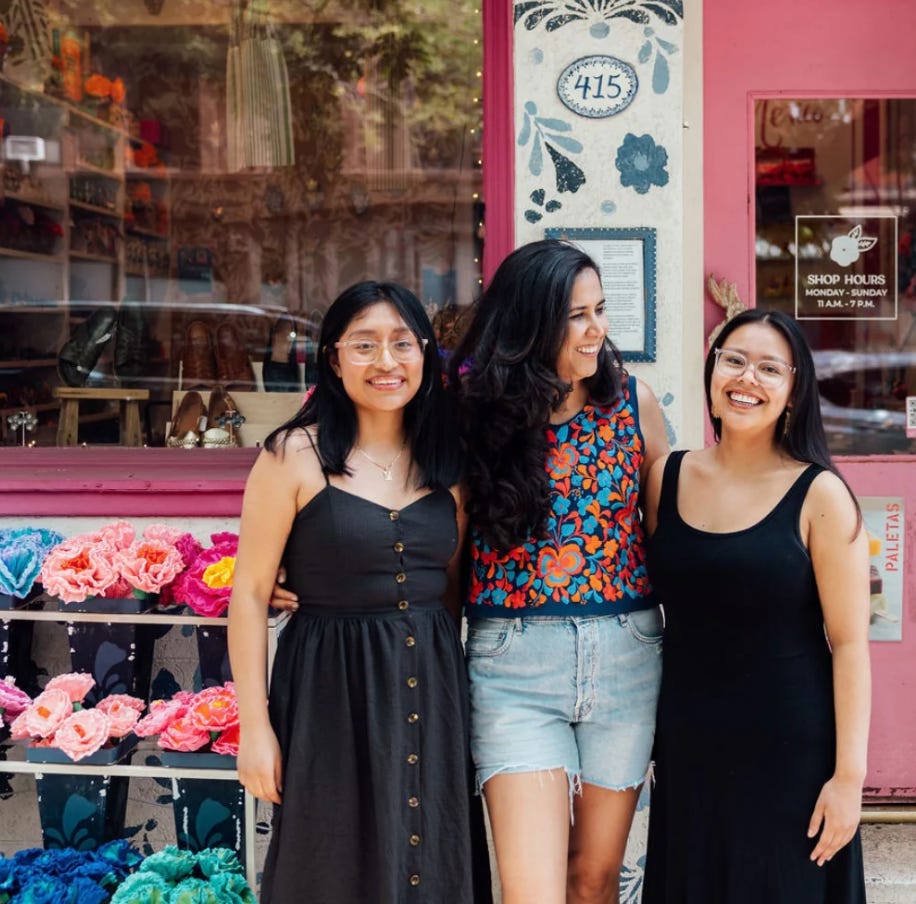
Mexzine: Through Mexico in My Pocket, you are an ambassador of Mexican culture and tradition. Do you think people still hold misconceptions about Mexico?
Luisa: That’s very kind, although I don’t really see myself as an ambassador. I see myself as a journalist and storyteller. I think it’s important to tell you my story. I grew up in Dallas; my mom is from Saltillo, and my dad is from Michoacán. My mom taught us Spanish from the time we were little because she wanted us to keep our culture, and in preschool, it was really hard for me to make friends because I didn’t speak English. As I started learning English, I heard little kids talking and saying very negative things about Mexico. I was only 4, and these are some of my first memories. I remember telling my mom I didn’t want to be Luisa anymore; I wanted to be called Hannah. I was struggling. And my mom said, “Luisa, being Mexican is the best, and I’m going to show you why.” She talked to my grandmothers, and they all started educating me. Instead of denying my identity, I fell in love with it.
As I grew older, I realized there were still many negative stories about Mexicans and Mexican-Americans, and I got so mad. I’m a doer, so I realized I had to stop complaining and do something about it. I was working in the news at the time, but the stories I wanted to tell weren’t getting picked up, so I created my own blog. I made it my life mission to tell positive stories about Mexico. That’s where Mexico in My Pocket comes from. It is about accepting our identity.
Mexzine: Your book, Mexico’s Day of the Dead, is a thoughtful and colorful immersion into Día de Muertos. What do you think attracts people (especially foreigners) to this holiday?
Luisa: Death is universal; death affects all of us. The #1 place that knows how to honor our loved ones is Mexico. In the US, when you talk about death, people get very uncomfortable. I have a personal story. My cousin Lila came to the US when she was around 12, and we became best friends. Growing up Mexican-American felt very lonely, but she was my person. She passed away at 24 from a stroke, and I had no idea what to do with that loss. I still grapple with that grief. I think people who experience loss are looking for meaning and answers.
Something that makes me very proud about our culture is the fact that there is always a seat at the table; there is always a reason to celebrate. But you have to be very respectful about these traditions. Some people are like, “Are you celebrating the devil on Día de Muertos?” That’s why I wrote the book. We’re not celebrating death itself. That’s not it at all. We are remembering and celebrating our own.
Mexzine: Through Mexico in my Pocket, you sell all sorts of beautiful crafts and ornaments for Día de Muertos altars. Have you noticed an increased interest in home altars recently?
Luisa: I think more people are reclaiming their identity. I have many Mexican-American customers who weren’t allowed to build an altar because their mom saw it as brujería, or they hadn’t seen a reason to do it. I love that people are reconnecting with their culture, and it’s never too late to do that. I do think people are more interested in the altar, and I think that opens the door for them to be curious about other aspects of our culture.
Mexzine: What have been the greatest joys and challenges of opening a brick-and-mortar shop?
Luisa: It’s one of the most challenging things I’ve ever done. Entrepreneurship is not for the weak. There are high highs and low lows. But I do it because I believe in sharing my culture. When people come in, I get to talk to them about it. I’m not a math person; I knew nothing about margins. I’ve had to learn a lot about running a business. But moments like having a Mexican-American come in because they are building their first altar keep me going. It’s about creating a space for us in a world where sometimes we feel like we don’t belong.
Mexzine: How do you find the craftspeople and artisans who you work with for the shop?
Luisa: I started Mexico in my Pocket as a blog in 2015. I did it for fun. I didn’t put my face on it. I was terrified. I ran the risk of the news network finding out and taking it away. I didn’t “come out” until I left the news world. It was technically a travel blog, and then COVID hit. That was when artisans started messaging me on Instagram, because they were struggling. They rely so much on tourism for selling. They asked if I could promote them, so I tried creating this dummy website where it would link to their product, but it didn’t work for two reasons: the cost of shipping was too high, and they wanted the customers to wire them money, but Americans were not comfortable with that. They really needed help, and I felt this responsibility. I set up Shopify, and people started buying products. I was so excited because the artisans were actually the ones who helped me. I felt like I had a purpose.
I find many artisans through Instagram, and others just by going to small towns in Mexico. I grew up in a home filled with Mexican crafts because my Mom loved them. She’s the reason I know about coconut masks from Guerrero, or milagros from San Miguel. I’m obsessed.
Mexzine: You are also designing trips to Oaxaca. How have people responded to those? Who is the kind of traveler who is searching for experiences like these?
Luisa: I went to France with my husband a few years ago, and I didn’t speak the language, so I felt very vulnerable. I realized many people who don’t speak Spanish feel like that in Mexico. A lot of people who join me have traveled to places like Cancun and want to experience a more authentic Mexico. A lot of them are younger women in their mid thirties or older women; sometimes couples. Overall, it’s people who are looking to learn more about culture and who want a real, authentic experience.


Now Open: Espacio Mariatinto, Valle de Guadalupe


For more than two decades, Mariatinto has earned a loyal following among Mexican wine lovers. Founders Chef Guillermo González Beristain – of Monterrey’s iconic Pangea – and oenologist Guillermo Falcón imagined a selection of wines for pairing not just with food, but with shared moments. Their vision now has a home in Valle de Guadalupe, Mexico’s top wine-producing region. Espacio Mariatinto, the brand’s first public space, offers its full selection by the glass or bottle, plus rare and special editions, with food for pairing. We can’t wait to grab a seat on the sunny terrace and sip on a chilled Mariatinto Blanco. – CA
Art Focus: Bienal de Yucatán


As if we didn’t have enough reasons to be obsessed with Mérida, the city is preparing to host a contemporary art fair: Bienal de Yucatán, from November 26, 2006 to February 28, 2027. Curated by artist Abraham Cruzvillegas and focused on language and its emotional and political expressions, the debut exhibition, VOCAL, will showcase 76 artists from 20 countries, including names like Bárbara Sánchez Kane, Mario García Torres, and Yoko Ono. Spanning 16 locations across the city, including Biblioteca Yucatanense and Gran Parque La Plancha, access to VOCAL will be completely free. – CA
And that concludes today’s issue of Mexzine. Want to send us a story idea, suggestion, or introduce yourself? Email us at Brandon@Mexzine.com or Cristina@Mexzine.com.
Past Issues:


